👋 Start here
This guide is your study companion for the 11084NAT Course in Asbestos Awareness. It covers the same material as the test — read each section, use the “Spot the asbestos” gallery to train your eye, and tick each section off as you go.
1 · The law (ACT)
Working with asbestos in the ACT is governed by a stack of legislation and codes of practice. You don't need to memorise them — just know they exist and set the rules.
- Work Health and Safety Act 2011 & WHS Regulation 2011
- Dangerous Substances Act 2004 & Regulation 2004
- Code of Practice — How to Safely Remove Asbestos (2014)
- Code of Practice — How to Manage and Control Asbestos in the Workplace (2014)
- Building Act 2004 · Construction Occupations (Licensing) Act 2004 · Environment Protection Act 1997
2 · What is asbestos — and why was it used?
Asbestos is a generic term for a group of naturally occurring fibrous silicate minerals. Because it was cheap and remarkably useful, it was used everywhere for most of the 20th century.
3 · A short history
4 · The six types of asbestos
There are six types. Three were used commonly; three appear only in trace amounts. (Watch out — Tellurite and Abelsonite are not asbestos; they're trick answers in the test.)
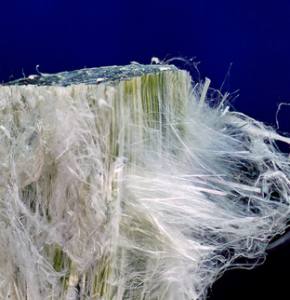
Chrysotile
The most common — about 95% of all ACM. Curly fibres. Brake linings, pipe insulation, gaskets, roofs, walls, floors.
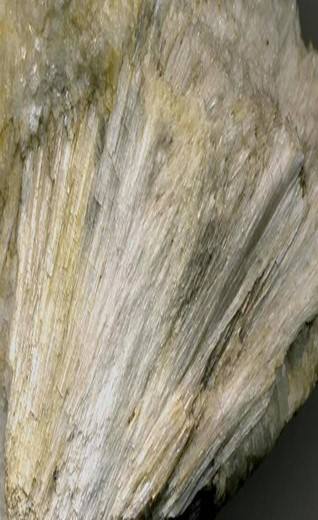
Amosite
About 4% of ACM. Needle-like fibres. Cement sheet, pipe & board insulation, ceiling tiles.
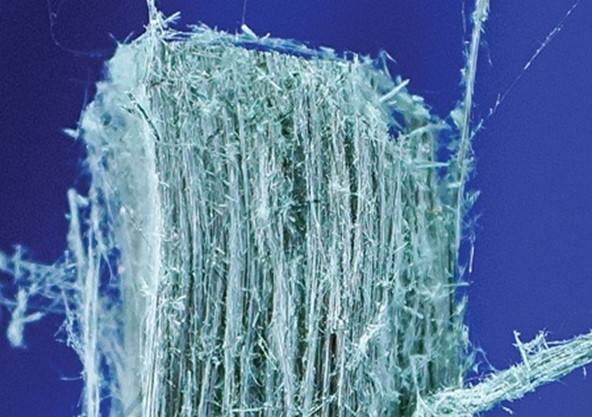
Crocidolite
<1% of ACM but the most dangerous. Best heat resistance. Steam engine & pipe insulation, spray coatings.
5 · Friable vs non-friable
Every piece of ACM is one of two kinds. This distinction decides how dangerous it is and who can work on it.
💨 Friable
When dry, it's a powder — or can be crushed or pulverised to powder by hand pressure. Fibres release easily. The most dangerous form.
🧱 Non-friable (bonded)
Asbestos locked in a solid matrix (like cement). Cannot be crushed by hand when dry. Generally not a health risk — until it's cut, drilled, sanded or smashed.
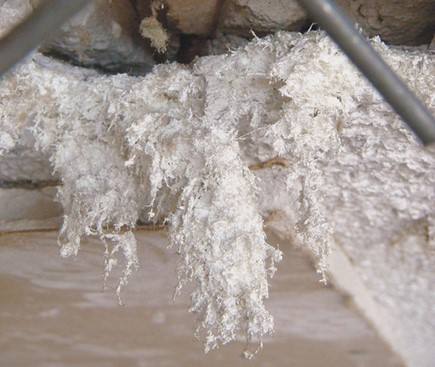
⚠️ “Mr Fluffy” loose-fill
From 1968–1979, pure loose-fill amosite was sold as ceiling insulation in Canberra homes. It's friable — easily disturbed, easily inhaled. A 1988–93 government program removed it, but some residual fibres remain in wall cavities and inaccessible spots to this day.
6 · Where asbestos hides
A residential building in the ACT built or refurbished between 1950 and the early 1980s, or a commercial building built before 2004, is likely to contain ACM. It can be almost anywhere — in buildings, in the ground, and even in vehicles and machinery.
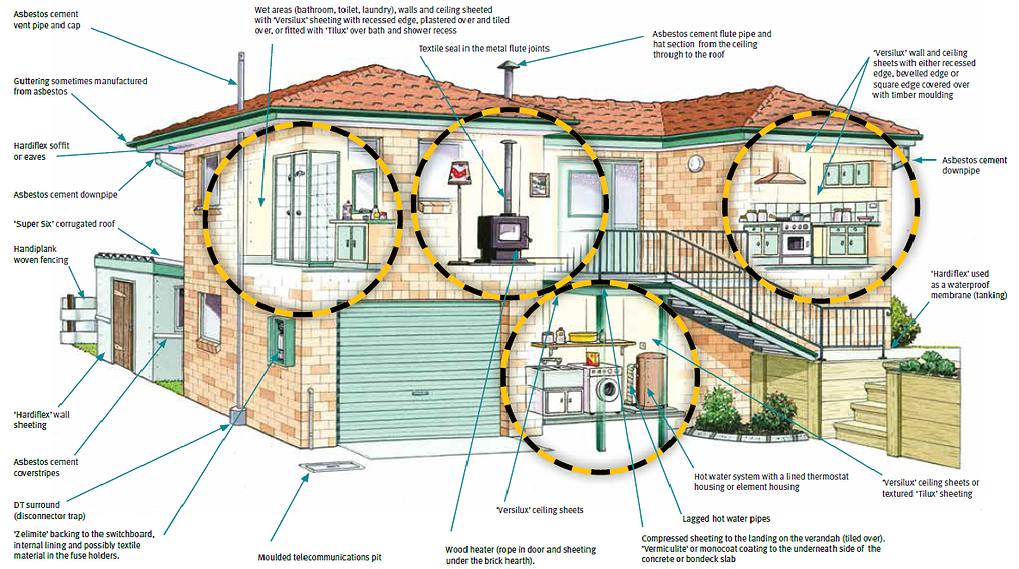
🔍 Spot the asbestos
Train your eye. Look at each photo and guess what it is — then tap to reveal.
7 · The asbestos register
An asbestos register is required for commercial premises constructed before 31 December 2003. It records every ACM identified — its type, condition and location — or states that none is present. Always check the register before you start work.
| # | Type | Friable? | Condition | Location |
|---|---|---|---|---|
| 1 | AC Roof Sheeting | Non-friable | Good, minor deterioration (Western end) | Whole roof, main building |
| 2 | Fibro Wall Cladding | Non-friable | Sound; paint lifting in places | Exterior of main building |
| 3 | Pipe Insulation | Friable | Cracked at bends | Plant room, behind boiler |
| 4 | Cement Flue | Non-friable | Good, coated | Plant room, on top of boiler |
| 5 | Floor Tiles | Non-friable | Good; tiles under cabinet lifting | Main office (vinyl floor tiles) |
8 · Health risks
Asbestos is a known human carcinogen. Inhaled fibres get trapped in the lungs, build up over time, and can cause serious disease decades later. The latency period is 10–50 years.
How bad the risk is depends on:
Asbestosis
Scarring of lung tissue from heavy, prolonged exposure. The lung hardens and breathing gets progressively harder.
Lung cancer
Fibres lodge in the lung lining, causing irritation, damage and malignant tumours. Treatment options are limited.
Mesothelioma
Cancer of the membrane lining (mesothelium) from inflammation and scarring. Australia has the world's highest per-capita rate.
9 · Managing the risk
Before entering a site, consider the building, consult, do a risk assessment, and check the asbestos register, management plan and assessment report. A simple model to remember is SAFE:
Hierarchy of risk control
Always start at the top. The higher the control, the more reliable the protection. PPE is the last line of defence.
10 · Removal & the law
Removal isn't always the best option — if ACM is in good condition, the safest choice is often to leave it undisturbed. When removal is needed:
- Only an appropriately licensed asbestos removalist may remove asbestos (except genuine minor/routine maintenance — see below).
- All friable asbestos must be removed by a licensed Class A removalist.
- The removalist must give at least 5 days' written notice to WorkSafe ACT and tell the person in control of the workplace.
- The person in control must warn everyone at, and near, the workplace before work starts.
Minor routine maintenance
Small, short tasks by a trained worker — sealing/painting to maintain non-friable ACM, or cleaning leaf litter from asbestos-cement gutters.
Minor work
Short, non-routine tasks done quickly & safely — replacing cabling in AC conduits, working on asbestos electrical boards, fitting downlights/switches.
Either way: follow the Codes, do a site induction, use safe procedures, correct equipment & PPE, decontaminate, and dispose of the material properly. In the ACT contact WorkSafe ACT.
11 · Your duties & rights
✅ Your duties
Follow reasonable safety instructions from your employer, and make sure your work doesn't put your own or anyone else's health and safety at risk.
🛑 Your rights
You can refuse or cease work if you believe it will expose you to an immediate risk. If you do, you must stay available for other duties.
A PCBU (Person Conducting a Business or Undertaking) must ensure exposure to airborne asbestos is eliminated or minimised, that the exposure standard isn't exceeded, and must pay for workers' health monitoring.
12 · If you find suspect material
🎯 Summary
You've covered the lot: the law, what asbestos is, its history, the six types, friable vs non-friable, where it hides, the register, health risks, risk management, removal rules, your duties & rights, and what to do if you find it.
- Left alone & in good condition = low risk. Damaged, disturbed or airborne = dangerous.
- Friable is the most dangerous form; Class A licensed removalist only.
- Assume ACM in ACT homes from ~1950–early 80s and commercial buildings pre-2004.
- Only a licensed assessor + NATA lab can confirm asbestos.
- Find it? Stop · don't disturb · report.
More info: worksafe.act.gov.au
Study as much as you like, then test yourself
Tick off the sections above as you study — when you're ready, take the test.
Take the Asbestos test →